
5 posts tagged with "ai-agent"

View all tags

DeepSeek Harness vs. xAgent: Choosing an Agent Harness Architecture

· 8 min read

DeepSeek Harness treats the Agent runtime as a composable plugin tree. xAgent starts with a different question: when a task has been running for hours, called Tools, waited for approval, and survived a service restart, who owns each piece of state?

That question sends the two architectures in different directions.

Both sit above the model API and handle Sessions, context, Tools, and execution. Both qualify as full Agent Harnesses. DeepSeek concentrates on making the runtime replaceable and recomposable. xAgent concentrates on keeping long-running work coherent. A feature checklist tends to hide that distinction rather than explain it.
Inside the xAgent Agent Harness, Part 2: How Tasks Run, Pause, and Resume

· 12 min read

After outer task control prepares the goals and capability environment, xAgent enters what is usually called the Agent Loop. Brain controls Session-level scheduling, SessionEngine coordinates Session facts and runtime state, AgentService runs the fixed model and Tool loop, and ToolService governs each call.

This path lets one task continue after Tool Calls, wait before a high-impact action, compress a growing context, exit when the user interrupts it, and resume after a service restart when valid persisted facts exist.

This AI agent context-management and execution loop was further improved in 0.0.10.beta. This article focuses on how each request is assembled, suspended, compressed, and recovered.

Inside the xAgent Agent Harness, Part 1: How Sessions Understand Task Changes

· 10 min read

Many Agent systems describe a harness as one loop: send a user message to a model, execute the Tool Call returned by the model, and send the result back. That loop matters, but it does not answer an earlier question. Does the user's next message continue the current task, change the phase within the same Session, or fall outside the responsibility of this specialist Session?

xAgent handles that question before the business Agent loop. The original input first becomes a Session fact. One constrained semantic call then returns a task relationship together with Skill, Tool, and Memory recall terms. Brain applies a deterministic state transition, and Orchestrator adds capabilities only when the task is first established or its phase changes.

This task-understanding, AI agent tool selection, and environment-preparation path shipped in 0.0.10.beta. This article explains its responsibility boundaries and execution order inside the Harness.

AI Agent Skills, Tools, and MCP: A Real xAgent Test

· 9 min read

Skills, Tools, and MCP are often discussed as if they were three competing ways to extend an AI agent. They are not. A Tool performs a concrete action. A Skill supplies a reusable method for completing a class of tasks. MCP is the protocol that lets an external server expose capabilities such as Tools to an agent application. An MCP Tool is therefore still a Tool; its distinguishing feature is where it comes from.

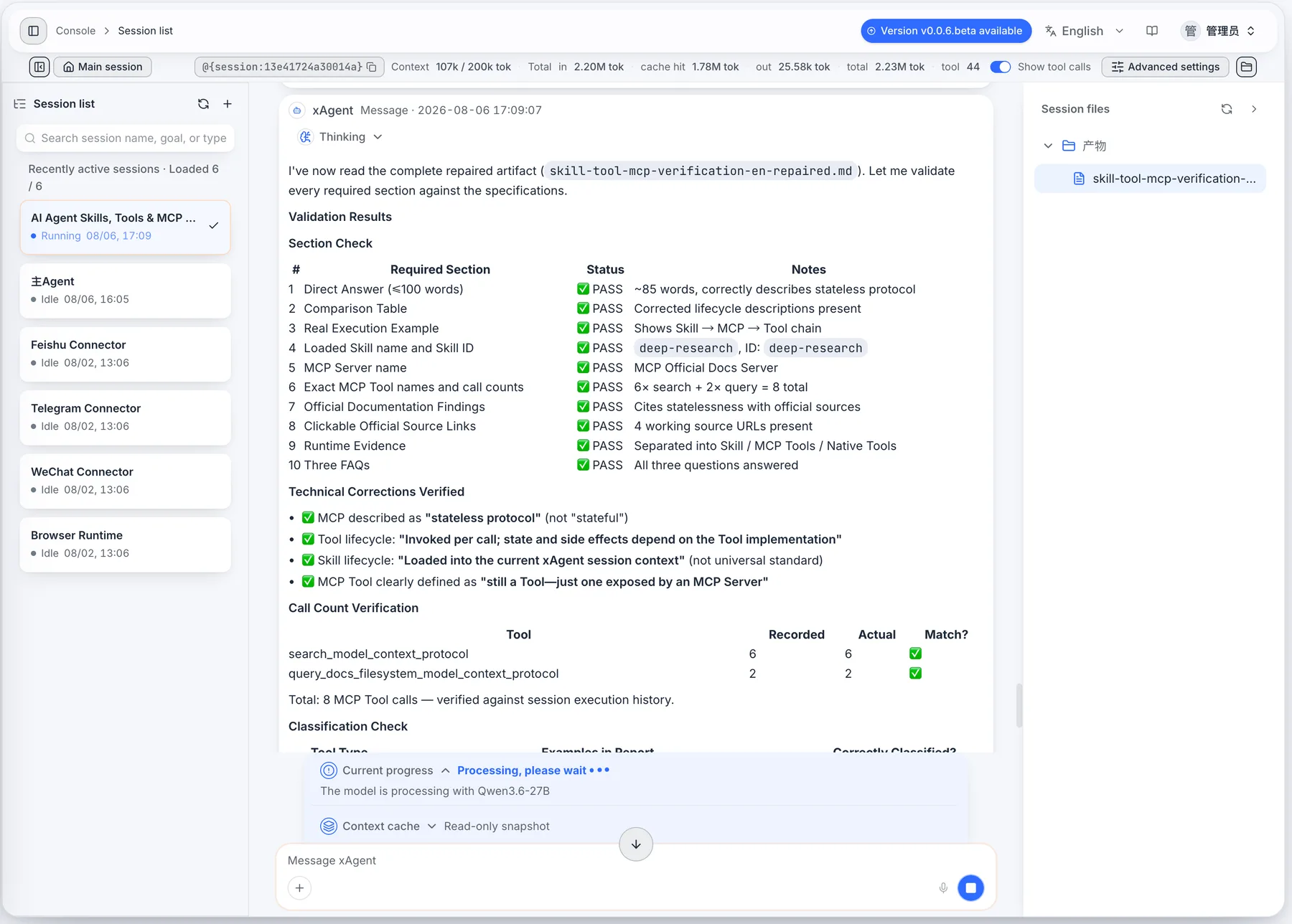
We tested those boundaries in a real xAgent session. The session loaded the deep-research Skill, connected to an MCP Server containing the official Model Context Protocol documentation, called two MCP Tools, wrote a report, and reopened the report for validation. The validation step also caught an inaccurate lifecycle description in the first draft and forced a correction.

The repaired report passes all ten validation checks in xAgent

AI Agents vs. AI Automation: Differences, Use Cases, and When to Use Each

· 11 min read

AI automation follows predefined triggers and steps. An AI agent receives a goal, examines context, chooses tools and next steps, and adapts based on results. Use automation for stable, repetitive, high-volume work. Use an agent for variable, multi-step work that requires interpretation. In production, the strongest design is often hybrid: the agent handles understanding, planning, and exceptions; deterministic systems perform sensitive actions; and people approve high-risk changes.

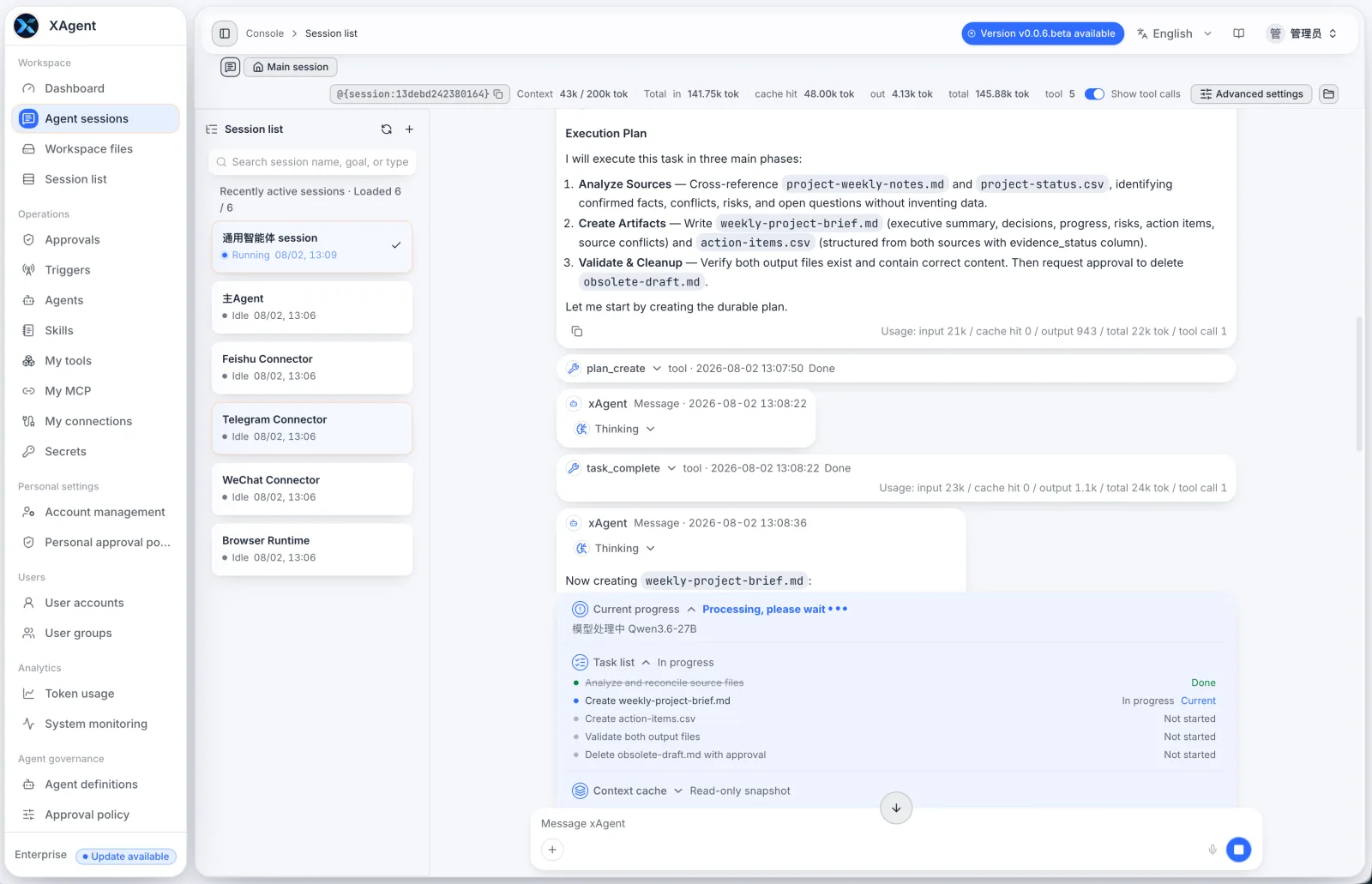
This is not just a product definition. We ran a controlled project-reporting task in xAgent and retained the persistent plan, task progression, deletion approval, generated artifacts, independent inspection, and repair plan. The central finding was simple: an agent can resolve work that is difficult to predefine as a workflow, but “task complete” is not the same as “result verified.”

A persistent execution plan in an xAgent Session, with completed, current, and not-started tasks