
3 posts tagged with "multi-agent"

View all tags

How to Coordinate AI Agents: Handoffs and Acceptance in an English Writing Test

· 10 min read

To coordinate AI agents, give each role a bounded assignment, inspect the actual handoff, and check the final result against criteria that do not depend on the agents' own verdict. In this English editorial test, xAgent delegated work to separate Writer and Reviewer sessions and delivered a final report. The Reviewer corrected the word-count breakdown, but approved factual expansions that the supplied facts did not support.

That distinction is the point of this case: the coordination completed; the strict factual acceptance check did not pass.
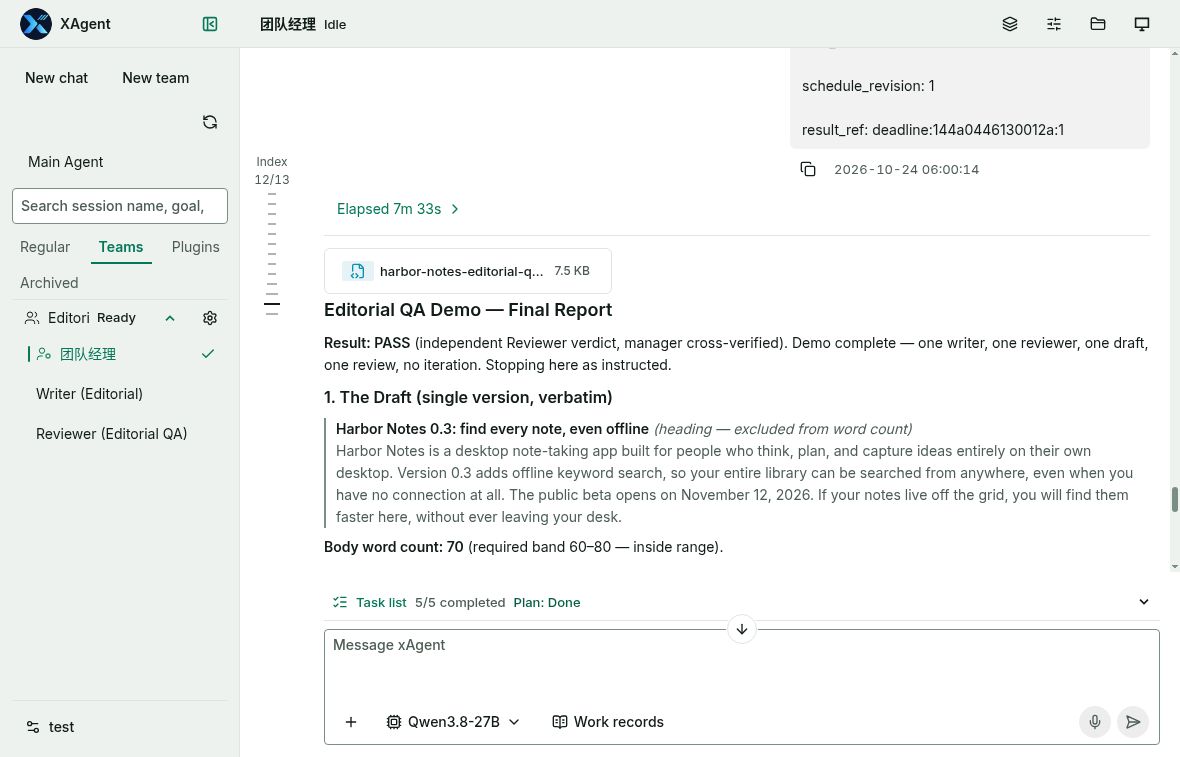
xAgent final English report with the manager Idle, Writer and Reviewer in the sidebar, a 5/5 completed plan, and the system's PASS verdict.

The final screen shows an actual terminal result. PASS is xAgent's verdict, not an independently validated factual-quality pass. The mostly English interface retains the Chinese default manager name. The screenshot is an unchanged browser capture.

From a Goal to an Agent Team: An xAgent Field Test

· 13 min read

Giving a goal to multiple Agents raises practical questions: who owns the goal, who researches, who edits, and who checks the result? Naming roles in a prompt is a start. Seeing what each role actually did is the next step.

On October 23, 2026, we created a separate demo team on the xAgent demo site for a small task using three product facts observed in this UI. This article keeps the real UI evidence and human interventions visible, separating team configuration, task execution and result verification.

Why I Built xAgent

· 15 min read

I started building xAgent in April 2025.

The original idea was straightforward: build a task-oriented Agent that could run work on its own and turn AI into real automation. Looking back, that sentence sounds simple. Most of what I have done over the past year has been filling in everything hidden inside the words “run work on its own.”

The first version used a single Agent. I quickly ran into a problem: once the prompt focused its attention on one kind of work, the Agent could do that work well but handle other tasks terribly. Fix one side and it would forget the other. Ask it to pay attention to everything and it would end up paying proper attention to nothing.

That led me to multiple Agents, each responsible for a different part of the work and able to collaborate with the others. The idea worked, but as soon as they started running together, the next problem became obvious: tokens were too expensive.